
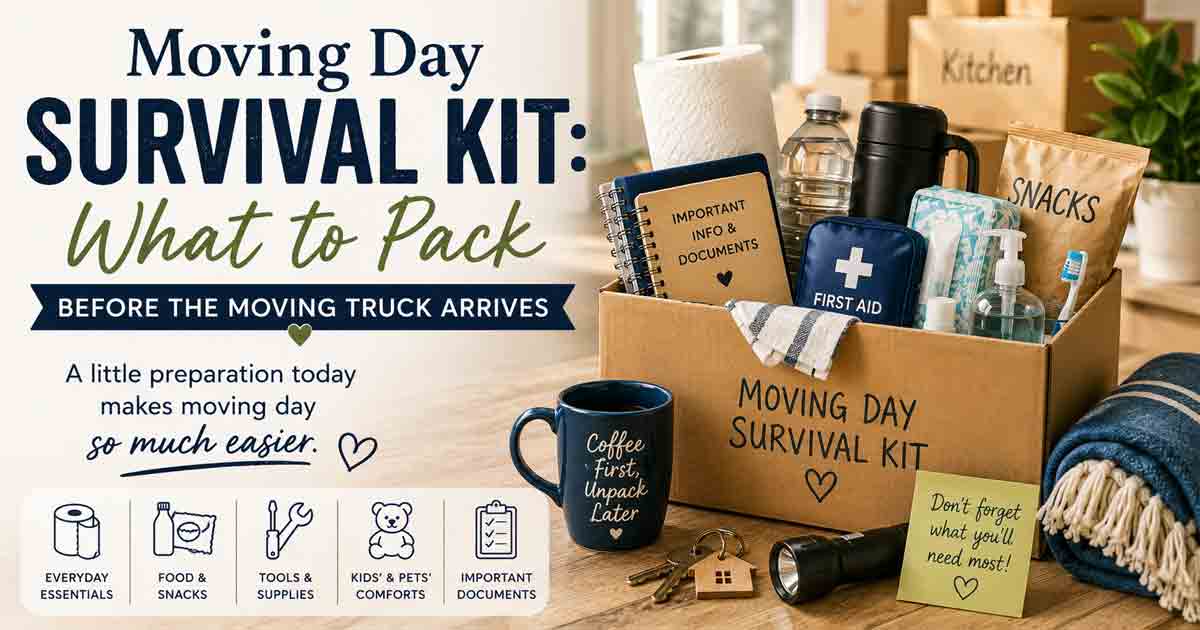
Moving Day Survival Kit: What to Pack Before the Moving Truck Arrives
Moving to a new home, whether it’s across the street or across the country, is exciting—but it is also stressful.
There are boxes everywhere, important decisions to make, and a long list of things that need to happen before you can finally sit down and relax.
One thing that can make moving day a whole lot easier is to prepare a Moving Day Survival Kit before the movers arrive.
I learned this from experience.
When my husband worked for the U.S. Forest Service, we moved every few years. Packing up our home, saying goodbye to friends, and dealing with all the logistics was difficult for both of us and for our two daughters.
After several moves, we learned something important:
There are certain things you don’t want packed on the moving truck.
You want them with you, where you can find them.
That’s how our Moving Day Survival Kits came about.
We even had our daughters create their own kits.
What Is a Moving Day Survival Kit?
A Moving Day Survival Kit is simply a collection of things you’ll need during the move and during those first few days in your new home.
It can be as simple as a box, tote, or backpack that travels with you in the car instead of going onto the moving truck.
Why is that important?
Because there is always the possibility that the moving truck will be delayed and you will arrive at your new home before your belongings do.
And even when the truck arrives on time, you’re not going to unpack everything immediately.
You may have dozens of boxes sitting in your new house and no idea which one contains the toothpaste, coffee maker, toilet paper, or phone charger.
Having your survival kit easily accessible can make a hectic day considerably less stressful.
The Most Important Thing in Your Moving Day Survival Kit
Toilet paper.
I’m not kidding.
The first thing I would put in a Moving Day Survival Kit is a roll of toilet paper.
You don’t want to arrive at your new home, discover that the bathroom isn’t stocked yet, and then have to search through dozens of boxes—or make a trip to the store.
Along with toilet paper, I would include:
- Paper towels
- Trash bags
- Hand soap
- Dish soap
- Dishwasher soap, if needed
- Sponges or cleaning cloths
- Toothbrushes and toothpaste
- Personal toiletries
- A small first-aid kit
- Any medications you need
These aren’t glamorous items.
But when you need them, you’ll be very glad you kept them with you.
Don’t Forget Food
One of the lessons we learned during one of our moves was that you can’t always count on having a working kitchen right away.
At the end of one move, we discovered that the gas range in our new home could not be connected for several days.
Fortunately, we’d planned ahead.
We had included foods that didn’t require cooking, including the ingredients for sandwiches, granola bars, breakfast bars, nuts, dried fruit, and other snacks.
We also had bottled water.
And because we knew we’d want something warm to drink, we had packed a small electric kettle along with tea bags, instant coffee, and instant soups.
That little bit of planning made a big difference.
Foods to Consider Including
Depending on your family’s preferences, your kit might include:
- Bottled water
- Granola or breakfast bars
- Nuts
- Dried fruit
- Crackers
- Bread
- Peanut butter
- Sandwich ingredients
- Cookies
- Instant coffee
- Tea
- Instant soup
- Other foods that don’t require cooking
If you include anything in a can, don’t forget the can opener.
That’s exactly the kind of little thing that gets packed in a box and becomes impossible to find when you need it.
Basic Tools and Supplies Can Be Lifesavers
You don’t need to pack your entire toolbox, but a few basic tools can save you a lot of frustration.
Consider including:
- Screwdriver or small screwdriver set
- Multi-tool
- Hammer
- Measuring tape
- Flashlight
- Scissors
- Utility knife
- Extension cord
- Extra batteries
- Phone charger
- Portable phone charger
You never know when you’ll need to tighten something, open a package, measure a space, or find your way through a dark room.
And after moving all day, you probably don’t want to unpack twenty boxes looking for a screwdriver.
Keep Some Basic Cleaning Supplies Handy
Even if your new home has been cleaned before you move in, you’ll probably want to do some cleaning once you arrive.
And things have a way of getting dirty during a move.
I’d keep a few basic supplies in the survival kit:
- Paper towels
- Sponges
- Cleaning cloths
- All-purpose cleaner
- Disinfecting wipes
- Dish soap
- Trash bags
You don’t need a whole collection of cleaning products.
Just enough to handle the inevitable little messes that come with moving.
Make a Survival Kit for the Children
Moving can be stressful for children, too.
During each of our moves with the U.S. Forest Service, I spent time with our daughters several days before moving day and helped them create their own survival kits.
They used backpacks and filled them with their favorite snacks, bottled water and juice, books, games, dolls, and other things they loved.
And, of course, their favorite teddy bear always went into the backpack.
I think giving children some control over what goes into their own survival kit can make moving feel a little less overwhelming.
Their backpack was something familiar that belonged to them, even when everything else around them was changing.
Ideas for a Child’s Moving Day Backpack
Depending on the child’s age, you might include:
- Favorite snacks
- Water or juice
- Coloring books and crayons
- Books
- Small puzzles
- Games
- A favorite toy or doll
- Headphones
- A favorite stuffed animal
- A comfort item from their old home
The goal isn’t to fill the backpack with everything they own.
It’s to give them a few familiar things that will keep them comfortable and occupied while everyone else is busy.
Don’t Forget Your Pets
Pets can find moving just as confusing as children do.
Make sure you have their food, water, bowls, medications, and any other necessities with you rather than on the moving truck.
If your pet has a favorite bed or blanket, keep that accessible, too.
Having something familiar in an unfamiliar house can help make the transition easier.
Your pet’s survival kit might include:
- Food
- Water
- Food and water bowls
- Leash
- Medications
- Favorite toy
- Bed or blanket
- Waste bags or litter supplies
- Any other items your pet needs every day
And remember that pets can sometimes get frightened during a move. Keeping them safely contained while doors are constantly opening and closing is important.
Keep Important Documents and Valuables With You
Your Moving Day Survival Kit is also a good place to keep the things you absolutely don’t want to lose.
Don’t put important documents, medications, jewelry, valuable small items, or anything irreplaceable on the moving truck.
Keep them with you.
This might include:
- Identification
- Insurance information
- Important papers
- Medical information
- Prescription medications
- Financial documents
- Keys
- Phone and computer chargers
- Jewelry or other valuables
These are things you don’t want to be searching through boxes for if the moving truck is delayed.
Pack for the First Night
One of the easiest ways to make your first night in a new home more comfortable is to pack as though you were going away for a short trip.
Think about what you would need if you were staying in a hotel for one or two nights.
Clothing.
Toiletries.
Medications.
Pajamas.
Towels.
Basic food.
Coffee or tea.
Phone chargers.
Anything else you know you’ll want before the rest of your belongings are unpacked.
You don’t need everything.
You just need enough to get through those first hours without having to hunt through boxes.
How to Organize Your Moving Day Survival Kit
You don’t necessarily have to put everything into one container.
In fact, I think it can be easier to have a few smaller kits.
One for the family: toiletries, food, medications, chargers, and basic supplies.
One for each child: their backpack with snacks, books, games, and comfort items.
One for the pets: food, bowls, medications, and familiar items.
One small tool kit: screwdrivers, flashlight, batteries, scissors, measuring tape, and other tools.
The important thing is that you know where everything is.
Label the containers if necessary.
And most importantly, don’t accidentally put them on the moving truck!
Can a Moving Day Survival Kit Be a Gift?
Absolutely.
If you have a friend or family member who is preparing for a move, a Moving Day Survival Kit can be a very thoughtful gift.
You could put together a basket or box filled with snacks, bottled water, coffee, tea, paper towels, trash bags, cleaning supplies, and other practical items.
Or make it more personal based on what you know about the person.
If they have children, include some treats or activities for the kids.
If they’re coffee lovers, make sure coffee is included.
If they’re moving a long distance, include foods that will travel well.
And if you don’t know exactly what they’ll need, a food gift can still be a wonderful way to welcome them when they arrive.
Sometimes the Best Moving Gift Is Help
Moving is a lot of work.
If you’re helping a friend move, don’t underestimate how much your time can mean.
Offer to:
- Watch the children
- Take care of the pets
- Make or bring dinner
- Pick up groceries
- Help unpack
- Clean
- Run errands
- Make a trip to the hardware store
- Simply be there
You don’t have to wait for someone to ask.
Sometimes the best thing you can say is:
“I’m coming over Saturday. What can I help you with?”
That’s a gift, too.
Once the Boxes Are Unpacked
Eventually, the boxes will be emptied.
The furniture will find its place.
The kitchen will become functional.
And the new house will begin to feel like home.
That’s when you can celebrate with a traditional housewarming gift.
But on moving day, don’t worry about making things beautiful.
Worry about making them easier.
A roll of toilet paper.
A cup of coffee.
A sandwich.
A flashlight.
A favorite teddy bear.
A pet’s familiar blanket.
Those may not sound like exciting gifts, but when you’re standing in the middle of a house full of boxes, they can feel like little miracles.
A Moving Day Survival Kit Is Really About Being Prepared
After all our moves with the Forest Service, I learned that you can’t prevent everything from going wrong on moving day.
The truck may be late.
The stove may not work.
The boxes may not be where you expect them to be.
Something will probably surprise you.
But being prepared for the little things can make the big things much easier to handle.
That’s what a Moving Day Survival Kit is really about.
It’s not about packing more stuff.
It’s about making sure the things you need most are right where you can find them.
And after spending the day surrounded by boxes, that’s a pretty good feeling.