
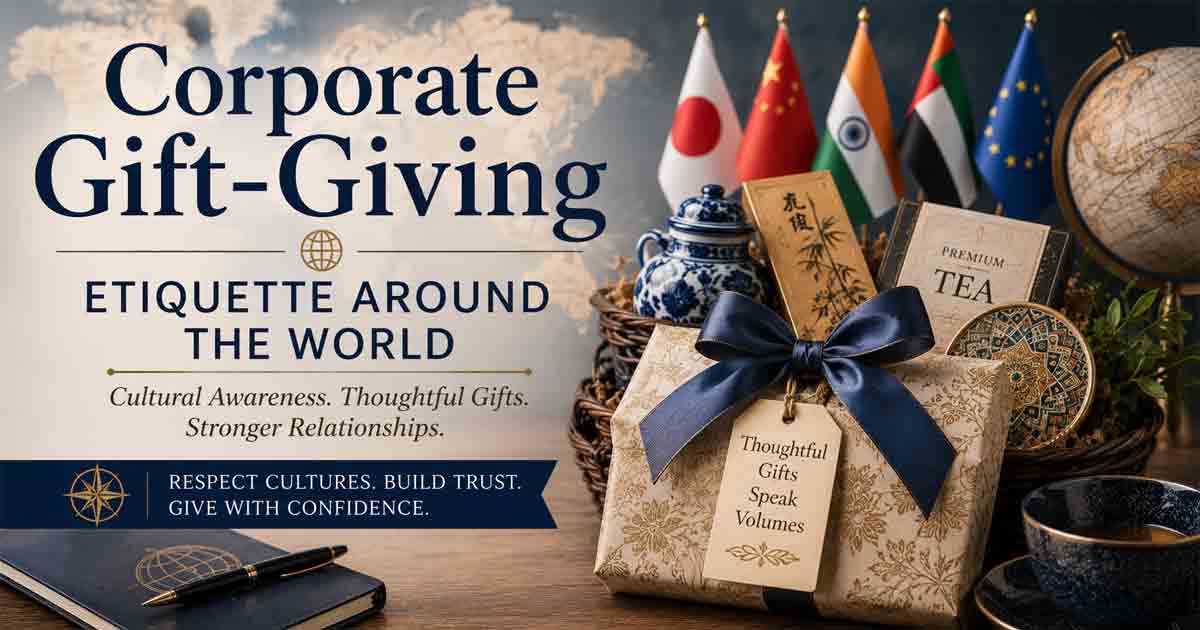
Corporate Gift-Giving Etiquette Around the World: What Businesses Need to Know
Giving a business gift seems simple enough—until the person receiving it comes from a different culture.
What is considered thoughtful in one country may be unnecessary, inappropriate, or even offensive somewhere else.
After all these years in the gift business, I’ve learned that choosing a business gift isn’t simply about finding something attractive and putting it in a box. It’s about understanding the person receiving it.
That becomes even more important when you’re doing business internationally.
A thoughtful gift can strengthen a relationship. The wrong gift, given at the wrong time or in the wrong way, can create an uncomfortable situation that you never intended.
So before sending a corporate gift across an international border, do a little homework.
Before You Choose the Gift, Check the Rules
There are really two kinds of etiquette to consider when giving a corporate gift internationally:
Cultural etiquette: What is customary and appropriate in that country?
Business and compliance rules: Is the recipient actually allowed to accept the gift?
The second question is particularly important.
Some companies have strict policies regarding gifts from vendors, customers and business partners. Government employees and officials may face additional restrictions. U.S. companies also need to be aware of anti-bribery laws, including the Foreign Corrupt Practices Act.
So don’t assume that because a gift is inexpensive or customary, it is automatically acceptable.
Check the recipient’s company policy first.
Then consider the cultural expectations.
Japan: Presentation and Ceremony Matter
Japan is one of the countries where business gift-giving can be an important part of establishing relationships. The U.S. Department of Commerce specifically notes that in some cultures, including Japan, gifts may be expected in business settings.
But the presentation can be just as important as the gift itself.
Traditionally, Japanese business etiquette places considerable emphasis on how a gift is presented. A carefully wrapped, appropriate gift demonstrates respect and thoughtfulness.
And don’t assume that the recipient will open it immediately in front of you.
The larger lesson is perhaps more important than any individual rule:
When giving a gift in Japan, pay attention to the ceremony surrounding the gift—not just the item inside the package.
If you’re unsure about the details, research the circumstances of your particular meeting rather than relying on a generic list of Japanese gift taboos.
China: Relationships and Thoughtfulness Matter
Business gift-giving is well established in China, and gifts can help reinforce business relationships and trust. The U.S. Department of Commerce specifically notes that gifts are well received by Chinese businesspeople and can strengthen relationships.
But there are some important considerations.
For example, clocks and watches are traditionally associated with bad luck in Chinese culture, so they’re best avoided as business gifts. The value of the gift matters, too. A gift that is extravagantly expensive can create discomfort if the recipient feels unable to reciprocate.
Presentation also matters.
And as with any international business relationship, don’t assume that every person or company follows exactly the same customs.
Research the individual relationship and the current business environment before choosing your gift.
What About Muslim Business Partners?
Gifting practices vary by country, culture, and the individual.
Food requires particular attention.
If you know your recipient observes Islamic dietary requirements, avoid gifts containing ingredients that may not be permissible, including pork and alcohol.
That doesn’t mean you have to avoid food gifts altogether.
Quite the opposite.
A carefully selected assortment of sweets, cookies, dried fruit or other appropriate foods can be a thoughtful business gift.
The key is knowing what you’re sending rather than assuming that an attractive food basket is automatically appropriate.
And if you’re uncertain, ask.
It’s much better to ask a respectful question than to unintentionally send something inappropriate.
Western Europe: Don’t Assume Gifts Are Expected
Western Europe covers a broad range of countries, cultures, and traditions.
There isn’t one universal European approach to corporate gifts.
For example, the U.S. Department of Commerce notes that gift-giving customs vary by country. In Denmark, business gifts are not a common custom.
Germany is another good example. The U.S. Department of Commerce says gifts may even be viewed as inappropriate in some German business situations, although a small, good-quality gift may be acceptable after negotiations or agreements.
So the lesson isn’t:
“Don’t give gifts in Europe.”
It’s:
“Don’t assume gifts are expected simply because you’re doing business in Europe.”
Research the individual country and situation first.
What About the Rest of the World?
There are hundreds of countries and thousands of cultural variations.
And the rules can change depending on:
- The country
- The industry
- The company
- The recipient’s position
- Whether you’re meeting for the first time
- Whether the gift is personal or for an entire office
- The occasion
- Religious considerations
- Local laws and company policies
A small gift that is perfectly appropriate for one business meeting may be completely wrong for another.
That’s why research is more valuable than memorizing a list of do’s and don’ts.
Five Questions to Ask Before Sending an International Business Gift
Before you send anything, ask yourself:
1. Is the recipient allowed to accept it?
Check the company’s gifting policy.
2. Is gift-giving customary in this business culture?
Don’t assume it is.
3. Is there anything about the gift that could be culturally inappropriate?
Consider food, alcohol, symbols, colors, numbers and religious sensitivities.
4. Is the value appropriate?
An extravagant gift can create an uncomfortable obligation—or raise compliance concerns.
5. How should the gift be presented?
In some cultures, presentation and the manner in which the gift is offered are an important part of the gesture.
When You’re Not Sure, Keep It Thoughtful and Professional
If you’re unfamiliar with the culture, you don’t have to get overly creative.
A high-quality, professionally presented gift that is appropriate to the recipient’s culture is usually safer than something quirky or highly personal.
Food gifts can work particularly well when you know the recipient’s dietary requirements.
A gift that represents your own region or company can also be a nice choice in some cultures. The U.S. Department of Commerce notes that gifts unique to the United States or carrying a company logo can be appropriate in China, for example.
And don’t underestimate the value of a simple message.
A sincere note explaining why you’re sending the gift can sometimes mean more than the gift itself.
The Most Important Rule of International Gift-Giving
If I could give someone doing business internationally just one piece of advice, it would be this:
Don’t assume.
Don’t assume that because something is considered polite here, it will be considered polite there.
Don’t assume that everyone in a particular country follows the same traditions.
And don’t assume that someone can accept a gift simply because you intended it as a gesture of goodwill.
Do your homework.
The U.S. Department of Commerce recommends researching a country’s history, culture, customs and business practices before doing business there—and specifically identifies gift-giving customs as one of the areas where cultural differences can matter.
That little bit of preparation can save you from an embarrassing mistake and, more importantly, demonstrate something every business relationship needs: Respect.
Final Thoughts
The best business gifts communicate appreciation without creating discomfort.
That’s true whether you’re sending a gift across town or across the world.
When you’re doing business internationally, however, the responsibility is a little greater.
Take the time to understand the culture.
Check the company’s gift policy.
Be aware of dietary and religious considerations.
Keep the value appropriate.
And when you’re uncertain, ask someone who understands the culture rather than relying on an outdated list of gift-giving rules.
Because ultimately, the purpose of a business gift is the same everywhere: to strengthen a relationship and let someone know that you value doing business with them.
And respect is always a good place to start.